
Asymmetric co-op explained: split areas, split information, unique tools and walkie-talkie teamwork. How Tomorrow's two-player design actually plays.
How Asymmetric Co-op Works in We Were Here Tomorrow
Asymmetric co-op means the two players never experience the same game. You walk different areas, see different information, and hold different abilities — and the only bridge between your two halves is your voice over the walkie-talkie. Neither perspective contains enough to progress alone; every solution is assembled from two partial truths.
Total Mayhem Games confirmed the structure explicitly on the official game page: each Explorer experiences different areas and information, success depends on sharing clues, and both Explorers have distinct abilities beyond their communication gear. If you understand this design before launch night, the first hour clicks instead of confuses.
The Three Asymmetries
| Layer | What it means | Example shape |
|---|---|---|
| Space | You are in different places | One in a lab, one in a shaft; neither can reach the other |
| Information | You see different facts | One sees symbols, one sees the legend; one hears the Director's clue, one sees the lock |
| Ability | You can do different things | One operates the machine, one reads the output; tools are unique per player |
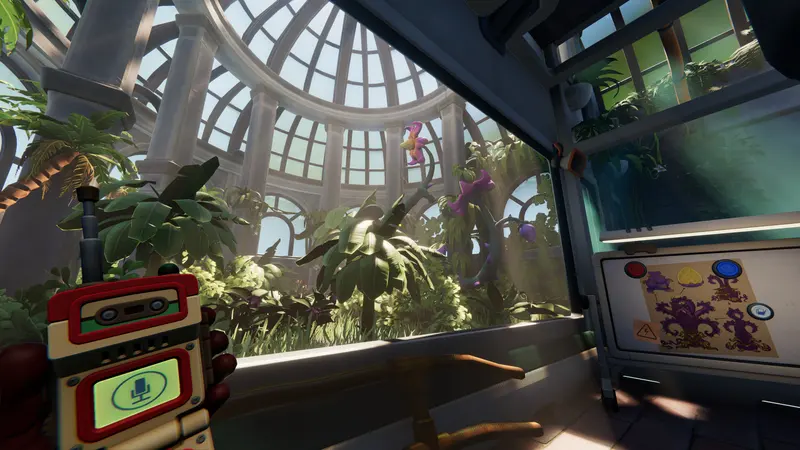
Earlier series entries built legendary puzzles on exactly these splits — one player describing chalk symbols while the other matches them, one reading a maze map aloud while the other walks it blind. Tomorrow inherits the formula with new dressing: walkie-talkies, unique tools, and the Norcek facility's terminals, greenhouses, and machine chambers.
Official source: Demo press release (key features)
The Walkie-Talkie Rule
The fiction equips each Explorer with a walkie-talkie; the reality equips each player with a headset. Treat them as the same object. Everything you know that your partner does not must travel through voice — there is no shared screen, no ping system announced (per the official Steam FAQ thread), and no way to show your display to your partner short of streaming it (which counts as cheating against the design, and against the fun).
Practical consequences:
- Describe, never point. "Top-left symbol" works; "this one here" does not.
- Your partner's ignorance is information. If they cannot see your chalkboard, the solution probably requires them not to — say what it shows, not what it means.
- Silence is a signal of failure. A quiet pair is a stuck pair. Narrate continuously, even when you think nothing matters.
Full technique lives in voice chat setup and beginner tips.
Who Should Play Which Side
No abilities are public yet, so no optimal assignment exists — but habits from the series transfer:
- Put the detail-oriented player on description duty. The side with charts, symbols, and dials needs patience and precision.
- Put the calm player on execution. The side pulling levers under time pressure needs steady nerves.
- Swap perspectives on replay. The developers note each game can be replayed from the opposite side — the second run is genuinely a different game, and the fastest way to appreciate the design.
Agree colors before starting (character guide) and keep them. "I am Orange for the whole run" prevents half the confusion asymmetric games produce.
How Puzzles Typically Flow
From the series formula and the demo's three puzzles (built to test teamwork, observation, and communication), expect this rhythm:
- Split — both players land in different areas with different tools.
- Survey — each narrates their room completely before touching anything.
- Hypothesize — combine the two halves into a theory over voice.
- Execute with read-back — the acting player repeats the instruction, then acts.
- Verify together — confirm the result on both sides before moving on.
Step 4 is where runs are saved. The read-back habit — repeating before acting — catches nine out of ten miscommunications while they are still free. When the loop breaks down anyway, what to do when stuck has the recovery protocol.
Streaming your view to each other, looking over a shoulder, or sharing screenshots bypasses the entire design. It also robs both players of the genuine "we figured it out" moment the series exists to deliver. Describe everything; show nothing.
FAQ
What does asymmetric co-op mean?
Each player gets different areas, information, and abilities. Progress requires combining both halves through voice communication.
Can both players do everything?
No. Tools and abilities are unique per Explorer, and areas are split by design. Some actions only one side can perform.
Is the game harder for one player?
It varies per puzzle by design — description-heavy sections load one side, execution-heavy sections load the other. Over a full run it balances out.
Do we need to be equally skilled at games?
No. Communication skill matters far more than gaming skill. Patience, description, and listening beat reflexes in every puzzle this series has shipped.
Related Guides
- How to play co-op with a friend — session setup step by step.
- Voice chat and microphone setup — the mandatory voice channel.
- The two Explorers — who holds which side.
- Beginner tips — habits that solve puzzles faster.
More We Were Here Tomorrow Wiki Guides
We Were Here Tomorrow FAQ: release date, price, crossplay, solo, co-op setup, PC specs, languages, story and series order — quick verified answers.
How long is We Were Here Tomorrow? Official length unannounced — honest estimate from series history: Forever took 10-12 hours. What to plan for.
All 16 supported languages in We Were Here Tomorrow: interface, full audio and subtitles per language, including Chinese, Japanese and Spanish.
Who is Norcek Industries and who is the Director in We Were Here Tomorrow? Every confirmed fact about the facility and its owner, spoiler-free.
We Were Here Tomorrow costs $19.99 with a 10% launch discount. Standard, Soundtrack and Fan Edition contents, and what two players must buy.
We Were Here Tomorrow launches October 20, 2026 on Steam, PS5 and Xbox Series X|S with full crossplay. Launch time, platforms and price facts.
No, We Were Here Tomorrow has no single-player mode. It is co-op only and both players need a copy. Options for solo players explained.
The story setup of We Were Here Tomorrow: the Antarctic expedition, the Norcek Industries facility, and the Director. Spoiler-free premise guide.